Showing posts with label activities. Show all posts

Small Group Scribe/Facilitators

Groups at Tables (all rights reserved)
At large group sessions, it may be a good idea to 'seed' small groups.  This involves having someone at each table with a good knowledge of the purpose of the session and the approach to be followed in small groups.

This person might be from the organising committee, or be someone else with appropriate capabilities.  This person needs to be able to:
  • Communicate clearly and succinctly.
  • Follow direction.
  • Give direction confidently and without being domineering.
  • Write legibly (if scribing).
As the facilitator, you need to give these people clear directions.  In addition to being aware of the purpose and process, I recently gave the following instructions:

  • Check that people know each other.
  • Ask if people are OK to speak; and ask them to get back to you later if there is anything they did not get a chance to talk about in the group.
  • Ask people to speak up if they disagree.
  • Remember that you are balancing accomplishing the task AND drawing people in (try not to do one at the expense of the other, but be flexible).
  • Listen and guide the discussion and keep the focus on the task.
  • Don’t venture an opinion unless no one else will.  Don’t write down an opinion of your own that no one else has endorsed.
  • Don’t ask everyone to endorse everything.
  • Signal me (Geoff) if the wheels are falling off the cart, or if you want some assistance.
I hope these directions are useful for you too.

...Geoff
www.performancepeople.com.au

Activities to Encourage Empathy - How Well Do We Know Each Other?

A Day in My Life (all rights reserved)
In the excellent book A Whole New Mind Dan Pink writes about an interesting activity which he calls "A Day in the Life".  I have not used this approach, but I hope to soon.

The activity is for working with an intact group in which people seem to lack insight into the work situation of their colleagues.  I think this will be particularly valuable if some of the colleagues work off-site or are quite introverted or isolated for other reasons.

The approach (with minor tweaking) is:

  1. Have each participant take a piece of Butchers' Paper and fold it in half twice (to make four equal-sized quadrants).
  2. Ask them to write their name on the top of the sheet, and to label each quadrant: My Highs, My Lows, My Frustrations and My Rewards.
  3. These 'posters' are blue-tacked around the walls.
  4. Everyone circulates around the room, writing what they think are the answers for their colleagues (not themselves).
  5. Then each person in turn stands in front of their poster and responds to their colleagues entries and explains what their workday is really like.  

If you've tried this approach, or a similar one, please add a comment about your experience.

...Geoff
www.performancepeople.com.au

Writing Clinical Notes & Daria

Daria Logo (source: en.wikipedia.org)
A couple of years ago I was asked by Centacare to work with clinicians on writing clinical notes.  This is important for both counsellor and client.  Well-taken notes have limited impact on the counselling session, while providing useful information for clinical records and to guide future sessions.

Counsellors have an unenviable task.  Anything that can be done to maximise outcomes and conveniently meet practice standards is valuable for these people.

I was struggling to figure out how I could give the participants a practical exercise in writing clinical notes on a low budget.  The solution I came up with was to show a dysfunctional family scene, and ask the students to write clinical notes summarising what they saw happening.

I asked the participants to take notes on the same scene, as I was interested in what was common across the participants' notes, and what they saw differently.  As I was teaching the SOAP Method of recording clinical notes, I was also interested in which elements they each recorded under each label - Subjective, Objective, Assessment and Plan.

I considered programs like Married with Children, Friends, Monty Python's The Meaning of Life, Neighbours, and others.  I kept coming back to Daria - a tv show about a sensitive, practical girl who is a goth (or who we would have called 'alternative' in my teenage years) growing up in a family in which she is misunderstood.  (That's a very short version of what it is about.  It is a show I really enjoy, and I recommend it to you.)

The segment I chose went for about two minutes.  Daria was in hospital with a stress-induced rash.  Her family was interacting with Daria, with each other, and with Daria's doctor.  Daria's perspective was being ignored, and Daria was developing a crush on the doctor.

The segment from Daria may seem trivial - after all, it is just a cartoon.  In the workshop it generated about 20 separate points, and resulted in a 30 minute discussion about the interactions and what they tell us about the relationships.  There was plenty of rich content to be turned into SOAP Notes.

Popular culture can be a useful piece of common ground, and the apparently trivial can lead to powerful interaction.

...Geoff
www.performancepeople.com.au

The Dictionary Method

The Method in Use (all rights reserved)
Difficulty:  Not really.
Audience:  People wanting to think laterally about a problem or opportunity.
Suggested Time:  5 to 20 minutes.

The Dictionary Method involves identifying a random word, and attempting to see how the word can help to better understand or address a specific challenge or opportunity.  Then identifying another random word and doing it again.  This is repeated a few times, taking notes all the while.

Many of the people who have used this method have been surprised by the results.  For example, people who participated in the Facilitation 101 workshop found this one of the most useful approaches attempted at the workshop.  When used and compared with the Six Thinking Hats and the Creative Whack Pack, a few groups have found the Dictionary Method easier and more likely to generate useful ideas.

One group was dealing with a challenging upcoming project for which a knowledge of government guidelines will be necessary.  The words they found included machete, animal spirit, romance, thalidomide and remount.  All were found to have links to the project - some comical and others serious.

Some people have not been impressed with the technique - the words have not been useful in furthering their understanding and thinking laterally.  This seems to be more likely to happen if the group feels the need to reject a number of words early in the process.

You might like to try it.  You (literally) never know what might eventuate.

...Geoff
www.performancepeople.com.au

INSTRUCTIONS
1. Agree on the challenge/opportunity.
2. Open the dictionary to a random page.
3. Without looking directly at the page, point a finger at a word.
4. Read out the word and (if necessary) it’s definition
5. Try to figure out what the word could tell you about your challenge/opportunity.
6. Give some time to ponder, but if there is nothing, move on to another word.
7. Finish by identifying highlights of the discussion.
And Again (all rights reserved)

See Things from Another Perspective

Difficulty:  Not very.
Audience:  People who are stuck and may be seeing their problem from one or a limited number of perspectives. 
Suggested Time:  5 to 10 minutes.

If you are in a hurry or short on resources, it is good to have a quick technique up your sleeve.  This is useful if people have a problem that seems intractable, or to deflect potential conflict, or even as an ice-breaker.  This approach encourages the important value of 'empathy', while being a useful method for solving problems.

The approach is to ask people to see something from the perspective of someone else.  Here are a few ideas to get your started:
  • How would you see the situation/act if you were a twitcher?
  • Or a 'roadie' with a rock band?
  • Or a telecommunications engineer?
  • Or a sculptor?
  • Or a scout leader?
  • Or your Mum?
  • Or a script writer?
  • Or a sheriff in the wild west?
  • Or your grade 4 teacher? 
This approach relies on some imagination, and often works well when people are in small groups, so they can pool their ideas.

If you have some other 'perspectives', please add a Comment.

...Geoff
www.performancepeople.com.au

The Forced Analogy Method

A Phone in a Small Tree (all rights reserved)
Difficulty:  Not particularly.
Audience:  People looking for a new perspective on a challenge or opportunity.
Suggested Time:  5-20 minutes.

Forced Analogy is a method of encouraging people to see a problem differently.  The method involves comparing and contrasting a problem or a product or a service or a situation with something completely different.

A Forced Analogy process I use with undergraduate students is to encourage the students to think of a mobile phone as a boat, and then as a tree.  I ask them what ideas a phone manufacturer like Nokia could draw from these analogies.

The boat analogy has resulted in:
  • How can we waterproof the phone?
  • Could we use timber in the construction?  Or fibreglass?
  • The white iPhone may be more nautical than the black one. 
  • Would the phone float or sink if it was waterproof?
  • How can we learn to compact things?  (A small boat's galley is like a shrunken kitchen.) 
The tree analogy has resulted in:
  • Again, the potential to construct in timber.
  • Could the phone network be drawn as a tree?  What represents the roots hidden underground?
  • Tree branches are irregular for easy grasping or gripping.
  • Could phones be organic?
  • Can photosynthesis replace or supplement battery power? 
  • Trees are often suited to their environment.  (Unfinished idea...)
  • Trees like to grow together.  (Unfinished idea...)
Give it a try.  What if your problem, or your product, was a tree?  Or a fence?  Or a piece of legislation?  Or an artificial limb?  Or a house in disarray?
(I'd love you to tell me about some ideas you identified in the Comments.)

...Geoff
www.performancepeople.com.au

The Bootcamp Bootleg (Stanford Design School)

Cover of the d.school Bootcamp Bootleg
Stanford Design School has developed a great tool for designers that is also of value to creative and innovative facilitators (and people facilitating creative and innovative processes).  The free PDF is full of tried and true methods to encourage people to identify and refine ideas.

Some methods from the Bootcamp Bootleg

Some of the methods are:

  • Extreme Users - people whose needs and solutions are amplified by their situation.  Can the layout of a car's dashboard be improved by examining the dashboard in a jumbo jet or a nascar?
  • Saturate and Group - plaster your immediate environment in cues about your project, using Sticky Notes or even miniature models; then group like-with-like.
  • Bodystorming - move beyond discussing, sketching and imagining, and set up a situation and act out the situation in a range of ways.  (I am yet to get one of my groups to try out this technique - I find it intriguing.)
  • Wizard of Oz Prototyping - I'm not giving this one away.  Go and find it and see for yourself what this is about, but first use your imagination:  What could this be?
  • User Capture Grid - this is a method of collecting feedback along the way or at the end - a useful technique for every facilitator.

As well as providing detailed instructions for each method, the PDF provides some excellent general advice on how to facilitate sessions, including:  "show don't tell" and "embrace experimentation".

I encourage participants in a couple of workshops to explore these techniques for their own purposes.

You can download the current (2010) version here.

...Geoff
www.performancepeople.com.au

The Creative Whack Pack Revisited

The Creative Whack Pack in Use (all rights reserved)
I have previously posted about Roger von Oech's Creative Whack Pack (including providing directions for using the cards).  The Creative Whack Pack is a set of cards with advice on how to be creative.  I thought I would return to this tool, given that the cards have been used in some of my recent innovation and facilitation workshops.

To recap, there are four types of cards:  ones with blue writing are the explorer cards which are used to understand the problem; the orange ones (artist cards) and green ones (judge cards) are used to create new ideas and review new ideas (respectively); and the red warrior cards give advice for implementing ideas.  Each card tells a story and encourages you to ask some questions about your situation, your problem and/or your potential solutions.  For an example click here to see a card at Roger von Oech's website.

At these workshops, responses to this creative method varied.  Everyone enjoyed reading the cards and discussing them.  Some people felt that the cards assisted them in addressing their opportunity or challenge; others felt that the cards were reliant on a longer lead time and other events to succeed.

One group using the cards were able to see their problem from some different perspectives.  They identified and gave consideration to some stakeholders that may be able to assist in overcoming a significant challenge.  They were also led by the cards to see some new ways to overcome barriers to implementation of their solution. They felt that the cards were very useful.

Another group expressed reservations.  An example that they used to explain these is a card which suggests that dreams can assist in finding creative solutions.  They felt that this did not help with their problem 'here and now'.

A problem which I expected was that some groups were distracted from dealing with their problem by the excitement of reading the cards.  This is overcome as people become familiar with the cards; but is common for groups when they are introduced to the cards for the first time.

I love the cards, and have enjoyed using the recently released iPhone app as a prompt for seeing things differently.

If you want to get the cards, you can order them through Amazon and other outlets.  Click here to go to iTunes if you are interested in the iPhone and iPad app.  You can also read Roger's blog here.

...Geoff
www.performancepeople.com.au

Changing 'On the Fly' (& Being Bitten by the Creative Bug)

Sometimes you are bitten by the creative bug, and you wonder whether to ignore it or scratch it.

This morning while walking from my car to the venue of my Decision Making workshop I was bitten.  The creative bug got me right on the topic I'd spent half an hour prepping this morning over breakfast (no, not last minute creation, but last minute 'putting my head in the right space').  The topic I'd prepared was a case study examining decisions made during a fire on the HMAS Westralia that killed four sailors.

The creative bug was of the 'keep it relevant' variety.  My audience are not sailors.  They are not with the Navy or any branch of the armed services.  They do not work with fire.  They are at a very low risk of being exposed to sudden and fatal fire in any aspect of their lives.  Westralia is not relevant.

I helped to set up the room; and before turning on the projector I 'hid' the slides I'd created on the Westralia, including a great photo of the ship at full steam ahead.  And I created a slide that said:
Universities are becoming “dual sector”.  As members of the University Council, you are considering whether to become a combined University and TAFE. 
How will you decide?
This topic is relevant at Central Queensland University, and it is current (as noted by the Vice Chancellor, Scott Bowman in his blog).  The participants are 'emerging leaders' at the University.

I asked the participants to work in table groups and answer the question on the slide, and they went for it.  As I hoped, they discussed process, risks, culture, stakeholders, decision making criteria and implementation challenges.  We covered these topics during the session, and this became a cornerstone topic for the rest of the session. 

...Geoff
www.performancepeople.com.au

Speed Storming (Brainstorming on Steroids)

Difficulty:  Moderate.
Audience:  People seeking ideas to address a problem or opportunity.
Suggested Time:  10 minutes.

There are many ways to spice up brainstorming, from getting people to type their input onto a common electronic whiteboard to getting people to rotate between different small groups at intervals.

I like to spice up brainstorming by asking people to do it really quickly.

The rules for Speed Storming are a lot like those for any brainstorming, but with tight deadlines.  You might wish to use a PC-based tool like the timer at www.online-stopwatch.com, or if you have a smartphone there will certainly be a timing app.

The rules are:

Identify the Topic
Be Positive
Admire others’ contributions
Make constructive suggestions
Smile
Build on Ideas
Pay attention to others’ input
Make suggestions that ‘grow’ ideas
Be Bold
Make BIG suggestions
Ignore costs
Verbalise
Say ‘I think we could …’
Or ‘Wouldn’t it be great if we …’
Instead of ‘Yes but’, say ‘Yes and’
Move Fast
Make a suggestion & move on
Take Note
A scribe writes the ideas down
(Number the suggestions)
Be Self-disciplined
Leaders go last
Everyone puts in 
Get Ready
Be clear on the topic
Assign a scribe & timekeeper
Later
Select the Top 3 (only 3!)
List actions with due dates
YOU HAVE 5 MINUTES!
Then you'll have 3 minutes to select your Top 3 & write brief action plans for each.

I have used this approach with students in an innovation lecture.  The topic I set is "Mobile phone batteries suck", and they tend to have lots of ideas to overcome or avoid this issue.

Image by Agripolare (no restrictions)
A risk with this approach is of course that there is no time for reflection, and the potential for responses resulting from reflection is diminished.  There is also a risk that people will not generate enough suggestions to make short-listing possible.  This has not been the case when I have used this method.  In fact, given the time-pressure (or perhaps due to it), it is amazing how many ideas can be produced.

This can be a great quick activity to get people to participate in small groups.

...Geoff
www.performancepeople.com.au

Stakeholder Analysis

Difficulty:  Moderate.
Audience:  People needing to better understand and involve stakeholders (eg, project managers).
Suggested Time:  20-60 minutes.

The Stakeholder Analysis can be used in a number of situations, including strategic planning, business planning, contract preparation, mediation, merger negotiations, etc.

It involves listing the organisation's stakeholders; identifying which of these are most important; and then closely examining the relationship the organisation has with these key stakeholders.

The first step is to create a mindmap of the stakeholders.
Example Stakeholder Mindmap
The second step is performed if you do not have the time or the inclination to closely examine all stakeholders.  In this case, you identify the most influential stakeholders from the mindmap.

The third step is to complete the Stakeholder Analysis table.
Example Stakeholder Analysis Table
You can complete this process alone or with a small group of key project people; or, for maximum impact, involve the stakeholders in completing the table.  They generally know best what they want, and how they might be involved.  Be careful not to over promise if you are using this tool early in a larger process.

You can choose what to label the columns in the table, depending on what you need to achieve.  I find the headings in the example above useful in many circumstances.

...Geoff
www.performancepeople.com.au

SWOT Analysis

Reporting SWOT Analysis (all rights reserved)
Difficulty:  Moderate.
Audience:  People seeking to better appreciate their organisation or situation in terms of the internal and external environment.
Suggested Time:  60 minutes.

SWOT Analysis falls into and out of favour at times (a bit like butchers' paper).  Although it can seem a little long in the tooth, if it is done properly it is a powerful tool for gaining a better shared understanding of the organisation and its context.

SWOT Analysis involves identifying the strengths and weaknesses of the organisation, and the opportunities and threats that confront the organisation (Identification Phase); analysing them to learn from the content (Analysis Phase); and documenting the outcomes (Reporting Phase).

IDENTIFICATION PHASE

There are some simple questions you can ask to identify each of the elements of the SWOT:
Strengths:  What are the great things we have? And, what things are we great at?
Weaknesses:  What important things are we missing?  And, what things do we do badly?
Opportunities:  What product, customer-focussed things do we do?  And, what is likely to happen that could give us an advantage over our competitors?
Threats:  What things are happening (or might happen) that could blindside us/threaten our ability to achieve our goals?
Rather than standing at the front of the room and writing down the elements identified by the whole group, it can be good to put the markers in the hands of the individuals identifying the elements.  You can do this by putting four pieces of butchers' paper in the four corners of the room, each with one label (strengths on one, weaknesses on another, etc).  Then you ask people to go to all four corners, reading what has been written, and adding their own items.  This can give participants a greater ownership of the process.

You may wish to separate navel gazing from looking outwards.  To do this, you can talk about the characteristics of the organisation, and ask people to identify strengths and weaknesses.  Then, you can separately ask people to identify opportunities and threats.

A big risk in doing a SWOT is superficiality.  Five items per heading is not thorough.  An even number of items per heading must be contrived.  Lots of items means lots of thought.  Also, short phrases do not provide the meaning behind the entries.  It may seem excessive to ask for complete sentences.  If so, make sure that everyone has a shared understanding of the meanings of the entries.  And do not try to limit the entries.  The more the merrier.  There will be plenty of opportunity to shortlist or prioritise in the Analysis Phase.

It is not unusual to have contradictory entries - one person sees deep (rather than broad) technical skills as a strength, and another sees these as a weakness.  They are a strength for as long as they are relevant, but they might result in a blinkered view.  Having a deep expert in kerosene lamp design may have been a strength until the light globe and household electricity became commonplace.  Having deep expertise in kerosene lamp design may have contributed to an inability to benefit from the new technology of electric light.  I like to leave contradictory entries alone; perhaps asking for clarification from their contributors.

ANALYSIS PHASE

The analysis can take many forms, including:
  1. Simply looking at the strengths, weaknesses, opportunities and threats, and discussing what these mean to the organisation.
  2. Selecting the Top 3 in each list and identifying how to exploit the strengths and opportunities and how to overcome or avoid the weaknesses and threats
  3. Literally drawing links (lines) between different elements - for example, seeking the strengths which help to extinguish a specific threat, or an opportunity that could assist in overcoming specific weaknesses, or the weaknesses that may diminish our ability to overcome a specific threat, etc.
  4. Categorising each element before examining them in their category groups.  Categories could include 'financial', 'human resources', 'products/services', 'reputation', and others. 
REPORTING PHASE

Often a SWOT Analysis is reported by just presenting a 2 column by 2 row table with each cell labelled Strengths, Weaknesses, etc, and the relevant elements listed in each cell.  This ignores the results of the 'analysis' - which was the point of the process.

Near to the table should be a list of questions, comments and conclusions that arose from the SWOT.

...Geoff
www.performancepeople.com.au

Activities to Draw People In - Sticky Notes For All

Difficulty:  Moderate to High.  (Needs firm facilitation and clear instructions.)
Audience:  People seeking ideas to address a problem or opportunity.
Suggested Time:  1 to 3 hours.

A popular method of visual facilitation is to put sticky notes up on a wall.  This takes many forms, from flowcharts or Value Stream Maps to organisational charts and brainstorming.

It is easy to control the session by being the one who sticks things on the wall, or to be even more in control by writing on the sticky notes and putting them on the wall.  Give it up!  Encourage the participants to share their ideas - by both writing on sticky notes, and putting them on the wall.  Or in some other way making a direct and unfiltered contribution.

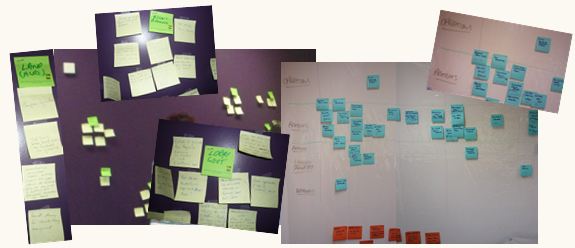
Sticky Noting in Action
EXAMPLE
My father lectures at U3A (University of the Third Age), and in a recent session on Islam he asked people to write on sticky notes what they know about Moslem people and Islam.  He then asked them to put the sticky notes up on the wall, not randomly, but on pieces of butcher's paper with labels like About Rituals; About People; and About Attitudes.  People were encouraged to sort their input under appropriate headings.  (The headings were chosen by the facilitator.  They were relevant to later topics.)

ANOTHER EXAMPLE
A client of mine (Fitzroy Basin Association) was producing a detailed report capturing the experiences in, and accomplishments of, lots of people's projects.  In this session, 8 people responsible for projects were asked to present for 6 minutes each - telling their audience 1.What we learnt; 2.What we changed; and 3.Where we can go with this.  The audience members were each given sticky notes and asked to write down the answer to the question "What is the key theme?"  They were encouraged to capture as many themes as they could identify.

After the last presentation, the audience became participants.  They put their sticky notes up on the walls - initially randomly, and then  moving them around to group in whatever logical way they could identify.  A group of about 20 people managed to write on 388 sticky notes that over an hour were sorted into 17 groups (or themes).  The themes were given descriptive names (mostly 2-3 word phrases).

We wanted more than just a list of themes.  For each theme we wanted to be able to tell stories.  So the participants were asked to go to a theme, and individually or in groups write a story about real events that explain the theme.

Learnings:  A. There was a high level of trust between the client, participants and facilitator in this session.  This trust was sorely tested as the sticky notes rained down, unable to stick to the painted walls.  Magic tape saved the day, with nearly 388 small lengths of tape being attached while people grimly held onto yellow pieces of not very sticky note - it was a hot day, and the wall had matt paint.  Not a good combination.
                 B. 388 separate pieces of information can be difficult to collate.  The first step was to take them off the wall, in groups, and stick them on butcher's paper.  The butcher's paper was then carefully folded up.  Each note was typed into Excel, and a short summary written to accompany the stories that explain the theme.

This was a great session for many reasons, including engaging all participants in collecting and collating information, and identifying a number of obscure themes that may not have been identified in any other way.  The session was at times a little stressful (raining sticky notes), but overall a pleasure to plan and facilitate.

...Geoff
www.performancepeople.com.au

You may wish to read what others have written about facilitating with sticky notes:

Eric Albertson at Duarte - Advanced Stickynoting
Chiara Ogan at Adaptive Path - How to Run a Concepting Workshop
And finally, a useful trick - Dave Gray at Communication Nation - The Amazing Sticky Note Trick

Activities to Draw People In - The Organisation's Story/ies

50 Year History of
Central Queensland Local Government Association
I am constantly fascinated by other people's stories...

One of the things I regularly do is to ask for a potted history of the organisation - perhaps in the form of recent events, successes and things people are not so proud of.  I ask questions like, "Is someone willing to tell me about the organisation's ‘recent successes’ and ‘notable incidents’?"  I have heard stories of fundraising, team achievements, embezzlement, failed change efforts and huge effort from volunteers.

Sometimes I do not need to ask - people love to talk about their organisations and the people who make them great.  If you feel that you need to know more about your client or their stakeholders, just ask.  You may be amazed at the enthusiasm with which people answer.

...Geoff
www.performancepeople.com.au