Showing posts with label participants. Show all posts

Which Space is Right For You?

Screenprint from sixminutes.dlugan.com
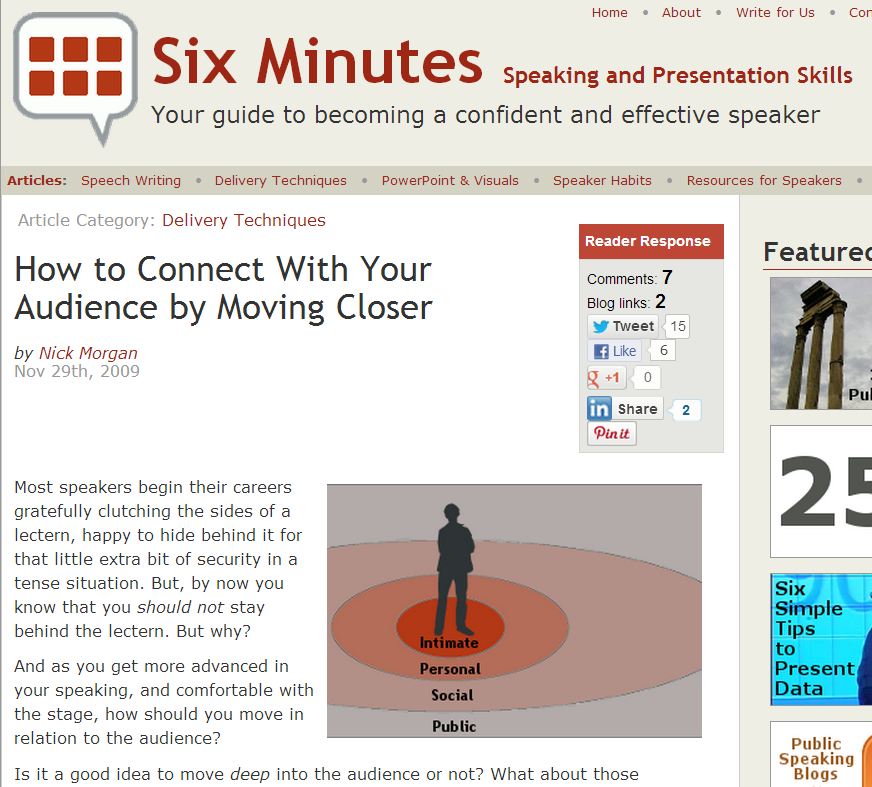
I have read this great post by Nick Morgan at Six Minutes a few times now:


It is written for public speakers, and contains some useful messages for facilitators too.  Each time I read it I take something different from it.  The stuff I really appreciate:

  • There are four distinct zones:  public, social, personal and intimate.  And we need to occupy 'personal space' to have an impact.
  • When we move towards someone they are more likely to trust us,and the converse is true too.
  • People have empathy for the observed experience of others, so we don't need to move into everyone's 'personal space' to have an impact on a larger crowd.
  • Avoid turning your back on people, as it communicates disinterest.

Extending what Nick has said:

  • If you are facilitating a session of more than a couple of hours, it is important to think about 'resting' people as well as making a 'world changing impression' on them.  Use 'moving back' to give them a break.
  • One way I 'move back' is to go and fiddle with my notes or make myself a cup of tea after I have given instructions for an activity.  If you stand close by, looking attentive, people can be distracted.  Let them get on with the activity.
  • If you are going to move forwards to emphasise what you are saying, give yourself some space.  Prepare for 'big messages' by moving back a little (or even a lot) first.

...Geoff
www.performancepeople.com.au

When to Hand Out Handouts?

Example Handout (all rights reserved)
There is some debate about whether you should provide handouts before or after the session.  I like people to have something to scribble on; I don't want them to write down things I have already written for them; and I am happy to give people a moment to scan the handout before starting.  So I am happy to give them the handout before I start.

There is a risk that people will drift off while reading the handout, make paper aeroplanes, or leave, as they now have the essence of what I will be talking about.  I am happy enough taking that risk, as I believe that what I have to say will be entertaining and informative enough to keep their attention.

I wonder how 'the people who choose to hold onto their handouts until they are finished' would feel if they came to one of my training workshops, and I did not give them the workbook until we were finished.

...Geoff
www.performancepeople.com.au

Not Finishing Quite Yet; Maybe Never Finishing

Scribbling (all rights reserved)
Urgh.  I've been here for hours.  The chairs are not comfortable. I am not enjoying the session.   The topic is wandering.  I have a strong streak of super ego saying, 'stay, you made the commitment, now stay to the end'.  The time they published to finish is long past.  (No, not 5 minutes passed, although I thought Urgh at about that time too.  No, about 35 minutes past - which is a more than 25% overrun, and counting.)  I actually need to do other things, even if my diary is blank for the next few hours.  The air is stuffy.  And they just keep going.  Why me?  Why now?

OK.  Let's get some perspective here.  All over the world there are people genuinely suffering.  I attended a school where speech night tended to go into the wee small hours.  This is good practice if I am ever approached to do a part (or worse, understudy) in 'Waiting for Godot'.  I could pull out my phone and catch up on email/Plants vs Zombies.  I could do Latin declensions in my head (if I'd paid attention at school).  I can continue to catalogue the body language of the other participants.  I could even pay attention, although I seem to be doing that, and it is not sufficiently interesting to dominate my attention.  I could doodle another 5 pointed star.  I could close my eyes, just for a moment.  No!  Don't close my eyes.  That would definitely be a mistake, compounded by my head rolling about on my shoulders, or crashing to the table.

  1. Why can't they offer to let people go (if they need to go)?
  2. Why can't they tell us what else they are going to do?
  3. Why can't they tell us how much longer they expect to go?
  4. Why can't they apologise for going past the published finish time?
  5. Why can't they ask permission to keep going?
  6. Why can't they start to wrap-up?
  7. Why can't they suggest that we reconvene in a couple of days?
  8. Why can't they ask whether a small number of people would like to reconvene in a couple of days?
  9. Why can't they call a break so the ones who have to go are not embarrassed to get up and leave?
  10. Why can't they finish?  Just finish.

These bullet points are not the result of a rambling mind.  (Well, maybe they are a bit.)  They are your choices when you go over the allotted time.  Whether you allotted it or someone else did, you are still responsible for the consequences of going over time.  So check the list and take appropriate action.  If you cannot or are unwilling to do the last one, do at least three of the others - any three, just make sure that they are relevant.  And if you do some things that result in us keeping going, make sure you keep it interesting and clearly on-topic, and that you finish soon.

Thank-you,

...Geoff
www.performancepeople.com.au

Contagious Difficult People

I am coming back to an old topic:  Dealing with Difficult People.

(Note:  There is some 'politically correct' language I'd like to address here.  I am all for "naming behaviours rather than naming names", and I was tempted to re-title this post 'difficult situations', so as to depersonalise these situations.  But realistically I am not talking about a situation devoid of players.  I am talking about how you deal with the fact that someone is standing out from the crowd for the wrong reasons.  Wrong for me as facilitator; wrong for the process we are following; wrong at this point in the process; and/or wrong for other participants who want to participate.)

Difficult people are a problem, as they put barriers in the way of success.  They can stop you from doing what you want to do, or take you where you do not want to go.

They are also a problem as their aggression/frustration/refusal cooperate can be infectious.  It can affect one or two people, or lots of people.  Some processes rely on people being forthcoming about topics they are uncomfortable about.  These can fail when someone rails against you or your process.  (Be careful here, I have intentionally used 'you' and 'your', as facilitators often have an inflated level of ownership of process, and even of the audience, but that is definitely a topic for another post.)

The infection can also affect you.  As the facilitator I am not immune.  I can be deflated by someone's negativity.  I may lose my way, or just feel negative about the approach.  I need to come across as confident or I will not be convincing.

I'd like to say that this contagion can be positive.  Maybe I'm being overly negative, but I'm really not sure that it can.  Here are some possible positives:

  • You get to see some shortfallings of your process, and can address them 'on the fly'.
  • This person gets their issues 'off their chest', and turns around to become a positive contributor.
  • Someone else (with or without influence) asks the person to cooperate.
  • By becoming aware of issues you can 'work them into' the process later in the session.

This is a tricky area.  Good luck with your difficult people.

...Geoff
www.performancepeople.com.au

Who Are You Facilitating?

Lots of people attend sessions that are being facilitated.  At any session, some of the following people will be in the room with you:
  • Middle managers caught between worker and management preferences and expectations.
  • Reluctant changers who are trying to join in, but may not yet be fully committed.
  • Flexible thinkers who can see their situations from a range of perspectives.
  • Fast adopters who embrace new technologies and new ways of doing things.
  • Shy, taciturn people reluctant to speak their mind. 
  • Dug in firm resistors who are willing to circumvent any attempts at change.
  • Overt wear my life on my sleeve types who are difficult to shut up.
  • A grieving person who just lost a significant person in their life.  They are bereft and there is probably nothing you can do.
  • Genuinely psychologically disturbed people who do not see reality in the way others do.
  • "The Boss" who may or may not be able to hold back until others have had their say. 
  • Frustrated facilitators who would rather have your role and be in control.
  • Analytical, scientists or engineers who crave factual information and tangible reality.
  • Distracted mobile device users who are only here in body while texting and tweeting.
  • A person who was told by their boss/colleague to attend, but has no idea about the topic.
  • Know-it-alls who (maybe correctly) believe that they have all of the knowledge they need on a topic.
  • Fatigue affected exhausted people for whom this seems a distraction from their real work (or sleep).
  • Caffeine and nicotine junkies who are twitching externally or internally awaiting their fix.
  • People with legitimate reasons to leave before you are finished, whether or not you finish when you said you would.
  • Reflective people who need to think things through before they respond.  They are slow to participate, but are not necessarily reluctant.
  • Evangelists who have a message to share, which is not necessarily useful,
  • Someone who rushed in late, and missed the introduction, but really needed to be there for it.
  • Technical, concrete thinkers unwilling to engage in 'what if' and other conceptual discussion.
How you treat these people is your call.  I am just letting you know that they are there.  And remember, the person who was a 'distracted mobile device user' at the last session might be the most eager participant at this session.  Leave behind any history you have, and try to treat everyone as a fresh participant every time.

...Geoff
www.performancepeople.com.au